

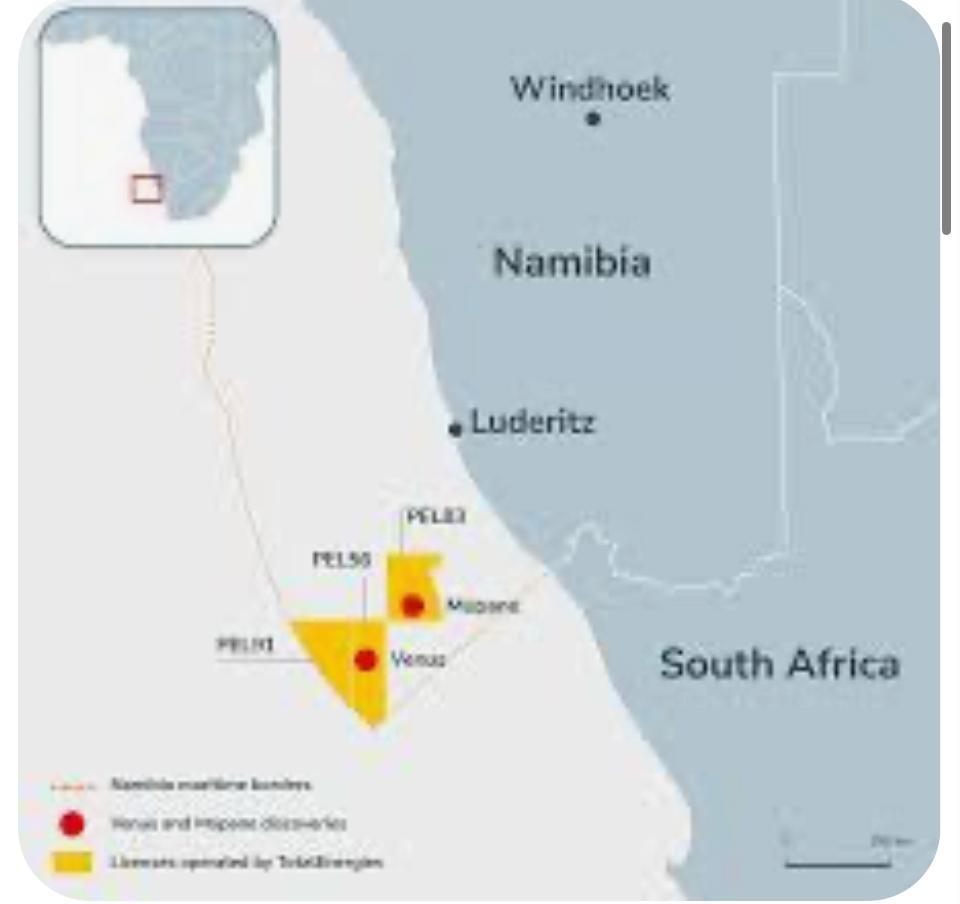
the Namibian government has officially commenced a technical and policy review of the Field Development Plan (FDP) submitted by TotalEnergies for the Venus oil project. This review is the final major step before formal negotiations and a Final Investment Decision (FID), which is currently targeted for Q4 2026.
Venus field is located in the Orange Basin, approximately 320 km offshore southern Namibia, in ultra-deep waters of about 3,000 metres.
Operator are TotalEnergies (45.25% stake)
And the partners QatarEnergy (35.25%), Impact Oil and Gas (9.5%), and the state-owned NAMCOR (10%).
The development plan includes up to 40 subsea wells and a Floating Production Storage and Offloading (FPSO) vessel.
Targeted first oil is expected in 2029, with an estimated production capacity of around 150,000 barrels per day.
An Environmental and Social Impact Assessment (ESIA) estimates the project will generate between N$127 billion and N$229 billion (approx. US$6.8B–$12.3B) for the Namibian government over 25 years.
Early government income will rely on royalties and export levies; Petroleum Income Tax (PIT) will only become the dominant revenue stream once development costs are recovered.
Negotiations are currently addressing unresolved fiscal terms and a dispute over gas injection, as Namibia prefers the gas output be supplied onshore rather than reinjected.
Parallel to the technical review, Namibia is updating its petroleum legislation and local content policies to prepare for its first major oil production. Shell recently wrote down $400 million in nearby assets due to reservoir issues, TotalEnergies remains confident in the Venus discovery’s unique geology. In early 2026, TotalEnergies further expanded its footprint in Namibia by becoming the operator of the Mopane discovery (PEL 83) through an agreement with Galp.
Note by Alessandro Bazzoni