

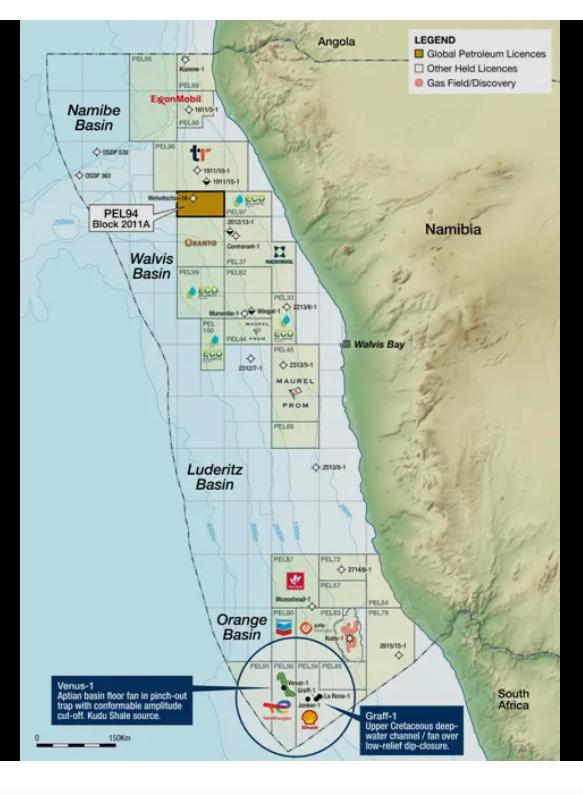
Namibia is projected to produce 400,000 to 500,000 barrels per day (bpd) of oil by the mid-2030s, fueled by massive offshore discoveries in the Orange Basin. Experts suggest this volume could be reached by deploying four floating production storage and offloading (FPSO) units, each capable of pumping roughly 120,000 bpd.Analysts at Mining and Energy Namibia note that four FPSOs could lift the country’s GDP by 25% while reaching a 400,000 bpd production equivalent by 2030.African If these targets are met, Namibia plans to become the fifth-largest oil producer in Africa, potentially displacing Egypt from the top five.While total in-place resources may exceed 20 billion barrels, recoverable reserves are currently estimated at 2–5 billion barrels.Major Discoveries Driving GrowthThe surge in production potential is led by several “supermajor” projects as the Mopane Field (Galp) Described by OilPrice.com as a massive discovery, it alone could involve two FPSOs pumping 120,000 bpd each the Venus Project (TotalEnergies)high-profile discovery with a final investment decision expected in 2026 and production likely by 2029.Graff/Jonker Complex (Shell) Estimated to hold up to 1.7 billion barrels, though Shell recently wrote down $400 million on a separate offshore discovery deemed unviable.Economic and Industrial
To avoid the “industrial trap” of exporting only raw minerals, experts in The Namibian advocate for local processing to act as an economic shock absorber.Transformation: The African Leadership Magazine highlights that these discoveries are shifting Namibia from a mineral exporter to a future global oil powerhouse.The country currently lacks the infrastructure to fast-track these ultra-deepwater projects, making development both expensive and technologically complex.
Note by Alessandro Bazzoni