

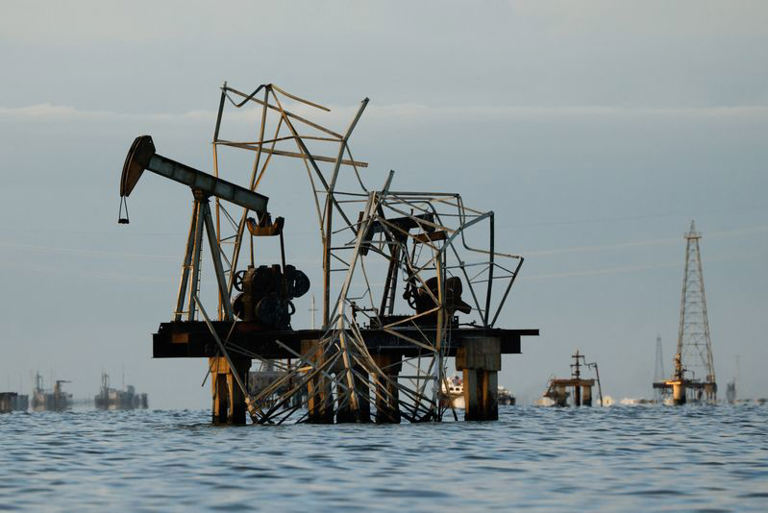
the Lake Maracaibo oil and gas sector is undergoing a volatile transition following significant political shifts and proposed legislative reforms in Venezuela. The region remains a focal point for international investment plans while continuing to face severe infrastructure and environmental decay.
Political & Legislative Reforms
Hydrocarbons Law Overhaul: In early February 2026, Venezuela’s parliament moved to pass sweeping reforms to the Organic Hydrocarbons Law. This “hybrid system” aims to dismantle decades of state control by allowing private firms greater participation and legal certainty to exploit oil independently or in partnerships.
Following the capture of President Maduro in January 2026, the U.S. has established an “interim government” and is overseeing oil sales. Approximately 50 million barrels of crude have already been transferred to the U.S., with proceeds held in restricted accounts in Qatar.
State oil company PDVSA aims for an 18% growth in production for 2026, building on a 2025 output that reportedly reached 1.02 million barrels per day (bpd).
Operational Challenges & Infrastructure
Severe Dilapidation for Decades of neglect have left Lake Maracaibo’s infrastructure—including 50-year-old pipelines and storage tanks—in a “post-apocalyptic” state. Gas leaks are so prevalent that bubbles are visible on the lake’s surface.
Investor Hesitancy: Despite a proposed $100 billion investment plan from the U.S. to “Make Venezuela Great Again,” major CEOs like Ryan Lance of ConocoPhillips remain cautious due to high fiscal and political risks.
The U.S. continues to maintain a “quarantine” on sanctioned vessels; in February 2026, U.S. forces boarded the Aquila II tanker in the Indian Ocean carrying 700,000 barrels of
Lake Maracaibo is heavily contaminated by chronic oil spills and toxic algae blooms (verdín), turning parts of the water black.
Local fishermen in Cabimas report massive net losses and depleted catches due to the pollution. There are concerns that new private investments, if not managed carefully, could further damage the area.
The oil and gas reserves of the Lake Maracaibo Basin are historically significant for their vastness and diversity, ranging from light, high-value crudes to heavy, asphaltic oils. However, as of February 2026, the quality of extracted resources is increasingly compromised by severe infrastructure decay and environmental contamination.
Crude Oil Quality
The basin contains a wide spectrum of crude types, typically categorized by their API Gravity:
Heavy and Extra-Heavy Crudes:
Dominating the eastern margin (Bolivar Coastal Fields), these oils generally have an API gravity below 22°.
Boscán Field: Produces a notably thick 10.5° API crude from the Eocene Misoa Formation.
Lagunillas Field: Characterised by high viscosity (over 4,000 centipoises) and gravity between 10.5° and 17° API.
Light and Medium Crudes:
Found in deeper Cretaceous formations and some Eocene sands, these are “vincit” (green) oils with API gravities ranging from 30° to over 42°.
Chemical Impurities: Much of the basin’s oil is classified as “sour,” containing high sulfur levels (often >1.3% and up to 5% in certain fields) and high concentrations of metals like vanadium and nickel.
Natural Gas Quality
Composition The region primarily produces thermogenic gas with a high methane content, often estimated at approximately 95%.
Associated Gas, Most gas in the basin is “associated,” meaning it is produced alongside oil. It frequently contains substantial concentrations of C2–C5 (LPG) fractions, offering potential for both natural gas and liquid petroleum gas production.
Waste and Flaring Due to collapsing infrastructure, a significant portion of this gas is either flared or leaked. As of 2026, methane emission intensity in the region is reported to be nearly 20% of production, a rate far higher than global averages.
Chronic spills from an estimated 10,000+ aging installations have led to “verdín” (toxic algae) and oil slicks that contaminate the water and local catch.
Refining Challenges: The heavy, sour nature of Maracaibo’s primary reserves requires complex, high-cost deep refining to produce high-value fuels like gasoline or diesel.
Investment Requirements
Total Capital Needs: Analysts from Rystad Energy estimate that $183 billion in investment is required by 2040 to restore Venezuela’s total production to 3 million bpd, with $81 billion specifically for non-upstream infrastructure like pipelines and upgraders.
Immediate 2026 Targets: The interim government expects $1.4 billion in short-term investments under new production-sharing contracts. An initial $30–$35 billion in foreign capital is needed within the next 2–3 years just to make a broader recovery viable.
Legislative Incentives: The January 29, 2026, amendment to the Organic Hydrocarbons Law aims to attract this capital by:
Allowing private firms majority control and operational autonomy in joint ventures.
Reducing royalty rates to a ceiling of 30% (adjustable based on project economics).
Permitting independent arbitration for dispute resolution.
Environmental Cleanup Plans
Initial Waste Removal: PDVSA has launched a recovery plan that has already removed over 1,795 cubic metres of hazardous solid waste and 2,040 cubic metres of non-hazardous waste from Lake Maracaibo.
Spill Containment: A presidential commission is overseeing the installation of temporary facilities to store crude-contaminated material and is implementing new protocols for selecting and containing active oil spills.
The “Blue-Green Buffer”: There is community-led pressure on companies like Chevron to fund buyouts of polluted residential areas (such as Cherokee Forest) to convert them into ecological buffers that filter industrial emissions and mitigate flooding.
Infrastructure Replacement: A core part of the “cleanup” involves replacing 10,000+ rusted pipelines and decaying compression plants that are the primary source of chronic leaks.
Chevron: Already the most prominent U.S. operator via a special licence, Chevron is best positioned to capitalise on the new laws. It currently holds stakes in Lake Maracaibo’s Petroindependiente (25.2%) and the Petroboscán (39.2%) field.
Halliburton: Cited by U.S. government allies as a primary candidate to lead the technical “rebuilding” of Venezuela’s broken energy infrastructure.
ConocoPhillips: Currently a priority claim holder for over $21 billion in seized assets, the company is weighing re-entry but remains cautious about legal and political risks.
The Williams Companies: Seeking damages through arbitration but noted as a potential participant in future natural gas infrastructure projects.
Chinese & International Companies
China Concord Resources Corp: A private firm that previously planned a $1 billion investment in two oilfields to reach 60,000 bpd by the end of 2026.
China National Petroleum Corp (CNPC) & Sinopec: These state-owned giants maintain long-standing joint ventures and are currently assessing their role under the new interim government.
Reliance Industries (India): Recently resumed buying Venezuelan crude, with other Indian refiners like Indian Oil Corp and Hindustan Petroleum Corp also snapping up cargoes in early February 2026.
BP & Shell: Have historical interests exceeding $4 billion and are monitoring opportunities to resume exploration and production, particularly in cross-border gas fields.
Emerging Private & Regional Players
Several smaller or regional firms have reportedly signed production-sharing agreements for specific fields:
Aldyl Argentina: Agreed to develop the Morichal field in the Orinoco Belt.
Alvarado & Cladoca Consortium (Brazil): Negotiating for field access.
Miller Energy Trading (Turkey): Listed as an interested trading and production partner.
Vulcan Energy Technology (Germany/Australia): Exploring technological service contracts for field revitalisation.
New Contractual Advantages (2026 Reform)
Under the February 2026 framework, these companies are negotiating for terms that were previously illegal:
Operational Control: Private firms can now directly manage technical operations rather than deferring to PDVSA.
Direct Marketing: Companies can now export and sell their share of produced oil directly with ministerial approval.
International Arbitration: New contracts allow for disputes to be settled in international courts rather than exclusively in Venezuelan courts.
note by Alessandra Bazzoni